The wireless charging coil is an important component of wireless charging, and it is mainly composed of copper wire and a ferrite chip. When powered on, the current in the coil generates an electromagnetic field; this magnetic field can be induced by the coil at the receiving end, thereby realizing power transmission and wireless charging. With the widespread application of wireless charging technology in the consumer electronics field, from smartphones to smart wearable devices, from electric toothbrushes to car chargers, wireless charging has become a standard feature of more and more consumer electronics products. As the core component of the wireless charging system, the specific specifications of the chosen coil directly determine charging efficiency, thermal management performance, and the overall user experience.
(★ If you want to know more about common-mode chokes, please refer to this article: •How Does a Wireless Power Supply Coil Enable Wireless Charging?)
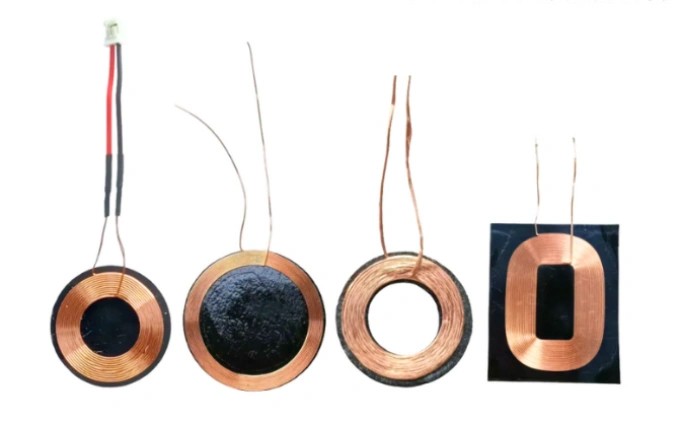
The parameters of wireless charging coils include inductance, quality factor, and resonant frequency. Below are explanations of several key parameters:
1. Inductance: Inductance is a primary factor determining the coil’s input and output power. Higher inductance results in higher output power and supports a wider range of input voltages and output currents.
2. Quality Factor: The quality factor is a parameter used to measure energy transmission efficiency within the circuit. Generally, a higher quality factor corresponds to higher output power and greater energy transmission efficiency.
3. Resonant Frequency: The resonant frequency is the operating frequency of the wireless charging coil. Typically, resonant frequency is inversely proportional to the coil diameter; therefore, the smaller the coil size, the higher the output power required to achieve the same performance.
There are two main types of materials used in wireless charging coils: copper wire and aluminum wire. Copper wire coils are more expensive but offer superior transmission performance because copper has higher electrical and thermal conductivity than aluminum. Aluminum wire coils are lower in cost but offer slightly inferior transmission performance, making them suitable for budget-friendly wireless chargers.
Wireless charging coils primarily come in two shapes: circular and square. Circular coils are suitable for charging pads, while square coils are suitable for charging stands.
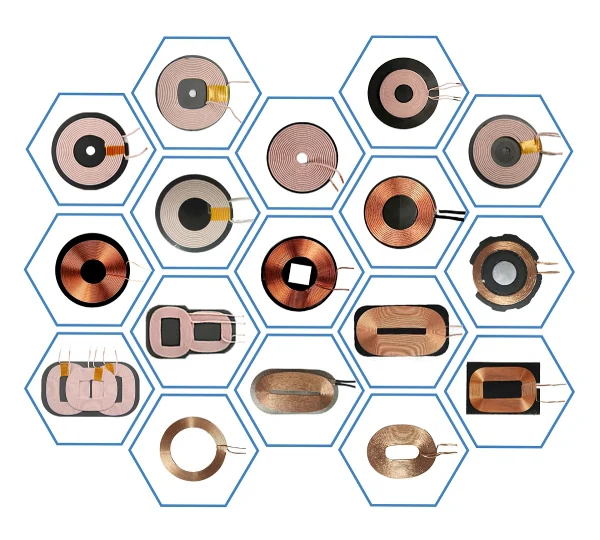
How to Choose the Right Wireless Charging Coil
When purchasing a coil, first consider your specific charging needs, such as the device to be charged and the required battery capacity and voltage. Next, consider your budget and performance requirements. Finally, take into account factors such as the seller’s reputation and the quality of their after-sales service.
1. Match dimensions and power ranges based on equipment type
Equipment type is always the top priority when selecting a model, as requirements for dimensions and power vary drastically across different types of equipment:
| Consumer Electronic Device Type | Recommended Coil Size | Compatible Power Range | Selection Criteria |
| Small wearables (smartwatches, TWS earbuds, etc.) | 30 mm or less | 1~5W | Prioritize flat coils to fit compact spaces and meet ultra-thin requirements. |
| Standard smartphones / portable power banks | Around 40 mm | 5~10W | Litz coils are sufficient, balancing efficiency and cost, and offering strong compatibility. |
| High-power fast-charging smartphones/tablets | Around 50 mm | 15W | Opt for a shielded design to reduce leakage flux interference and improve coupling efficiency. |
| Thin-and-light laptops / multi-device charging stations | 50–60 mm or more | 20W+ | The preferred Litz wire design ensures high-frequency performance, coupled with a good heat dissipation design. |
2. Selecting the Structure and Manufacturing Process Based on Core Requirements
Once dimensions and power specifications have been determined, the appropriate manufacturing process should be selected based on the product’s core requirements:
- For transmitter products that must balance efficiency and cost, Litz wire coils offer the best cost-performance ratio.
- For receiver coils integrated into devices, PCB coils are better suited for mass production when precision and consistency are critical.
- For compact wearable devices with strict thickness constraints, flat coils are the ideal choice to align with the structural design.
3. Balancing User Experience and Budget When Selecting Coil Layout
- For entry-level, cost-effective products: Opt for a single-coil layout combined with magnetic alignment assistance; this controls costs while meeting basic usage needs.
- For mid-to-high-end products prioritizing user experience: Choose a multi-coil layout to expand the effective charging area, support “drop-and-go” placement and simultaneous multi-device charging, and enhance product competitiveness.
4. Key Performance Verification: Avoiding Selection Pitfalls
Finally, performance verification is crucial to avoiding common pitfalls in the component selection process:
- Thermal Balance: While larger coils offer higher coupling efficiency, they also generate more heat. If the device has limited space for heat dissipation, avoid indiscriminately selecting oversized coils; excessive heat can lead to power derating or even accelerate battery performance degradation.
- Compatibility Verification: To achieve cross-brand compatibility, select coils that comply with the Qi protocol (specifically the latest Qi2 standard) and ensure the coil size matches the protocol-specified power class. Do not use low-power coils in high-power applications, as this may pose a safety hazard.
- Shielding and Foreign Object Detection (FOD): Large coils (exceeding 50mm) require high-permeability shielding materials (such as ferrite or permalloy) to minimize leakage flux interference. Additionally, ensure the coil design is compatible with FOD circuitry to prevent overheating caused by metallic foreign objects.
- Cost-Performance Trade-off: Large coils and multi-coil layouts often entail higher costs. Balance performance against cost based on the product’s market positioning rather than blindly pursuing high-end specifications.
This concludes the guide on selecting wireless charging coils for consumer electronics. Although other parameters and factors such as inertia and electronic load need to be considered when selecting a model, we have provided the core information needed for selection. If you are interested in purchasing wireless charging coils, please contact us at info@smdinductor.com. Zhenhua is a trusted inductor manufacturer capable of meeting your specific requirements.