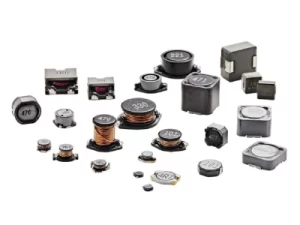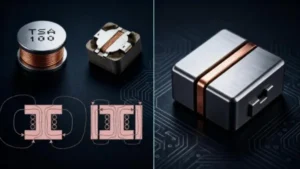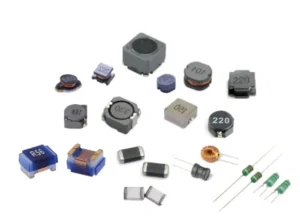
Among the surface-mount components inside the humidifier, the core element is a 3-pin inductor (also known as a coupled inductor or autotransformer), which serves to step up the voltage to drive the atomizer. Working in conjunction with this, surface-mount capacitors form an LC resonant circuit, while surface-mount resistors handle functions such as current limiting, voltage division, and signal sampling. Each component plays a specific and essential role; none can be dispensed with.
So, what do these three components in a humidifier each do?
3-pin inductor: This is the “heart” of the atomization circuit. It contains two sets of windings (primary and secondary), functioning essentially as an autotransformer. Working in conjunction with a MOSFET switch, it steps up an input voltage of approximately 5V to the high voltage—reaching tens of volts—required by the atomizer. This drives the piezoelectric ceramic element to vibrate at a high frequency, thereby generating a water mist.
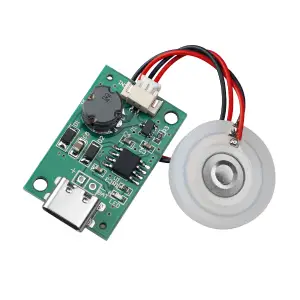
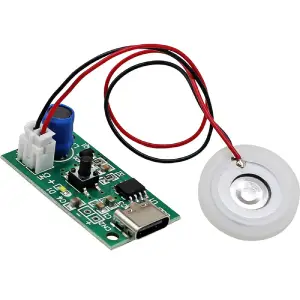
SMD capacitor: Forms an LC resonant circuit in conjunction with a 3-pin inductor. When the PWM frequency approaches the atomizer’s natural resonant frequency (approximately 110 kHz), the circuit impedance reaches its minimum, energy accumulation reaches its maximum, the step-up effect is optimized, and atomization efficiency is maximized.
SMD resistors serve relatively fundamental functions: primarily limiting current, dividing voltage, providing bias for startup circuits, protecting MOSFETs and ICs, and stabilizing operating points.
The function of a 3-pin inductor is to step up a low voltage—typically around 5V—to several tens of volts, in order to drive a piezoelectric ceramic atomizer. In terms of its structure, it can be viewed as two inductors connected in series on a single magnetic core; consequently, it is specified with two inductance values—for example, `25uH:800uH`.
The 3-pin inductor is a key component for enhancing power efficiency. Its performance is truly impressive. Whether it’s a small, home-use facial mister or a high-capacity humidifier for the office, there is a suitable model available. Many users have reported that, with the addition of this inductor, their devices operate more smoothly and with noticeably less noise. For atomization equipment that requires long periods of continuous operation, this is undoubtedly a significant advantage.
Wiring method: Connect the common terminal to the PWM signal (controlled by the chip and MOSFET); connect the short side (the end with smaller inductance) to the power supply (VCC); connect the long side (the end with larger inductance) to the atomizer.
Working principle: When the PWM signal is high, the end with smaller inductance stores energy; when the signal is low, the end with larger inductance generates a high voltage, thereby achieving voltage boost.
Common Models: In humidifiers, the most frequently used types are surface-mount device (SMD) components, such as the `CD75`, `CD54`, and `CD0805` series. Typical inductance values include `25:800µH`, `30:600µH`, and `10:500µH`.
In a humidifier, a surface-mount (SMD) capacitor typically works in conjunction with an inductor to form an LC resonant circuit, which determines the operating frequency of the atomizing component.
Operating Principle: Capacitors and inductors generate oscillations through repeated charging and discharging, facilitating a continuous conversion between electrical energy and magnetic energy. The frequency of this oscillation is determined by the values of the inductor and the capacitor.
Primary Functions: In addition to forming a resonant circuit in conjunction with an inductor, capacitors are frequently used near power sources for filtering and decoupling, thereby helping to stabilize the power supply.
Surface-mount resistors are primarily used for functions such as current limiting, voltage division, and signal sampling—for example, limiting the current flowing to an indicator light, dividing the voltage for a control chip to monitor voltage levels, or sampling the current in a power supply circuit to provide feedback signals for control.
Identification method: Components typically have a numerical code printed on their surface; for example, “103” represents 10 kΩ (i.e., the digits “10” followed by three zeros).
Common package sizes: Small household appliances, such as humidifiers, frequently use package sizes like “0402,” “0603,” and “0805.” Generally, a larger package size corresponds to a higher power-handling capacity.
So, what do these three components in a humidifier each do?
The main control chip outputs a high-frequency PWM signal, which is then amplified by a MOSFET. This drives an LC resonant circuit (consisting of an SMD inductor and an SMD capacitor) to step up the voltage. The resulting high-voltage signal powers a piezoelectric ceramic atomizer, causing it to vibrate at a high frequency, which breaks the water down into a fine mist.
It is worth noting that the “core SMD components” of a humidifier are not the atomizer itself. The atomizer is a thin sheet made of piezoelectric ceramic—it is not classified as an SMD (surface-mount device) component. The actual SMD components are all located on the main control board.